
A Concert Evening with a Distinct Dramaturgical Signature
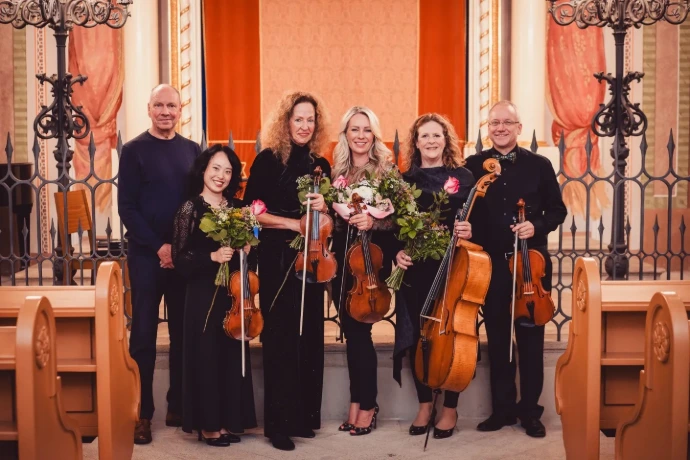
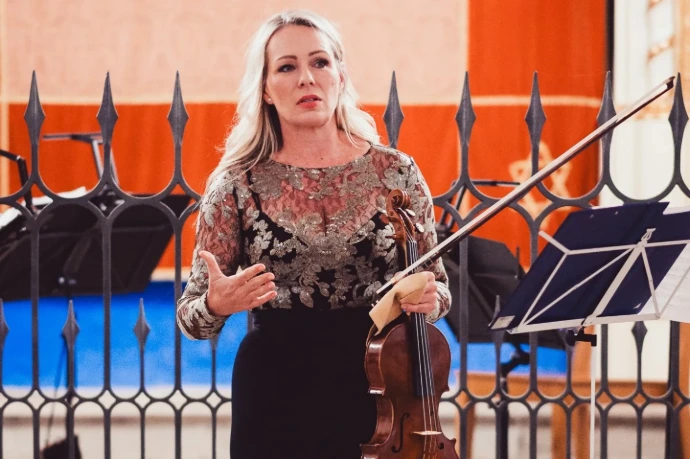
In our artistic work, we are particularly interested in concert evenings in which works from different eras do not merely stand side by side, but enter into an inner relationship with one another. This is precisely what shaped our concert on 12 September 2024 at the Old Synagogue in Pilsen. As part of the festival Procházky uměním, we were able, together with violist Jitka Hosprová, to create a programme that placed German and Czech music within a broader European context.
Pilsen as a Resonant Space
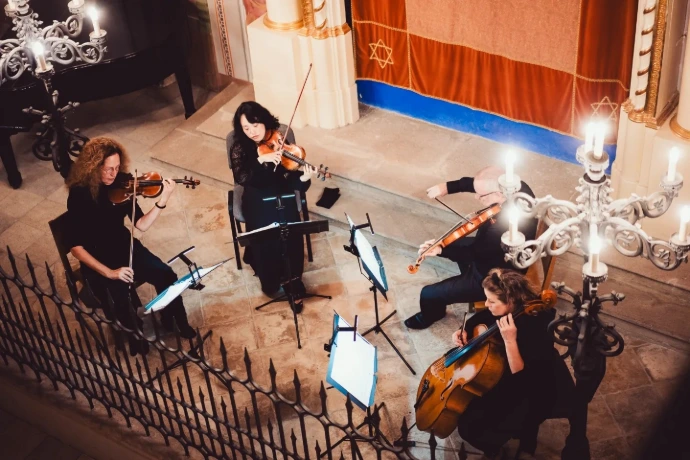
For us, Pilsen was far more than simply a performance venue that evening. The Old Synagogue is an architecturally and historically striking space that lends chamber music a distinctive presence. Places like this sharpen listening, intensify ensemble playing, and make subtle tonal nuances perceptible in a particularly vivid way. For a string quartet especially, this connection between space, concentration, and musical precision is of great importance.
Mozart, Dvořák, Mendelssohn, and a Contemporary Perspective
The programme of this evening reflected our artistic self-understanding in a particularly meaningful way. It opened with Mozart’s String Quartet in C major, K. 157. This was followed by two pieces from Dvořák’s Cypresses, as well as music by Holmer Becker and Mendelssohn’s String Quartet, Op. 44 No. 1. For us, it is precisely this combination of classical clarity, Romantic expressiveness, and a contemporary perspective that gives a dramaturgically conceived concert evening its particular appeal.
Collaboration with Jitka Hosprová
An essential part of this concert for us was the collaboration with Jitka Hosprová. Artistic encounters of this kind not only expand the sonic spectrum, but also open up new interpretative perspectives. With Hindemith’s Sonata for Solo Viola, Op. 25 No. 1, the evening received a distinctive soloistic accent, while the shared conclusion with music by Telemann once again made the dialogue between soloist and quartet audible in a special way.
Chamber Music as a European Dialogue
Looking back, the concert in Pilsen represents a line that has shaped our work for a long time: chamber music as a connection between precision, programme conception, and cultural openness. What interests us is not merely the sequence of individual works, but the shaping of a musical context in which eras, traditions, and sonic languages enter into relation with one another. For us, the evening in Pilsen was therefore a particularly striking example of how artistic identity can be condensed within a specific concert format.
Insights into a Grown Concert Tradition
Appearances of this kind stand for an artistic continuity that has shaped the Esterhazy Quartet for many years. Concert evenings such as the one in Pilsen show how strongly our work is sustained by dramaturgical care, differentiated ensemble playing, and a clear European perspective. It is precisely in this that we see an essential quality of chamber music: as an art form that is demanding, contemporary, and at the same time conscious of tradition.